I wrote a book
I wrote a book. It comes out on Amazon on 15 October and you can pre-order it now.
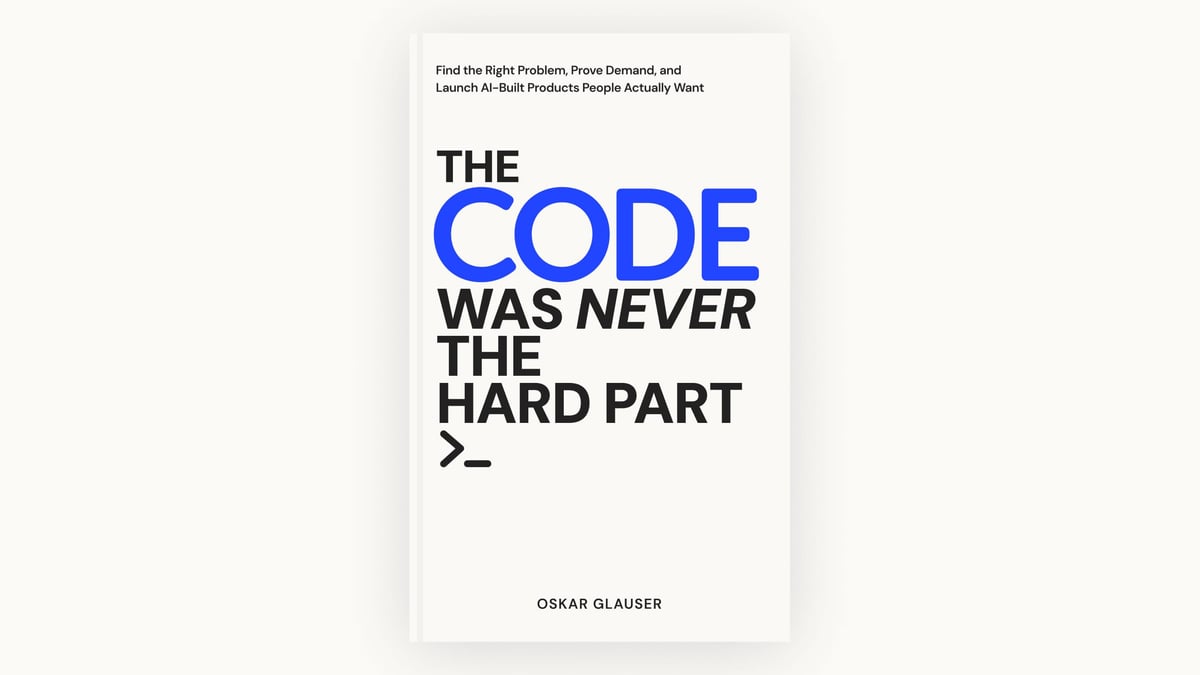
It’s called “The Code Was Never The Hard Part: Find the Right Problem, Prove Demand, and Launch AI-Built Products People Actually Want”. If the first half of that sounds familiar, it should. It started life as a post on this site and then kept growing until it stopped being a post.
The argument is one line. You can build anything now, so why does nothing land? App stores are full. Launch platforms list hundreds of new AI-built tools every week. Most are dead within months, and not because they were built badly. Plenty of them are fast, polished and genuinely well made. They flop anyway.
What’s in it
Fourteen chapters and two appendices, short enough to read in a weekend, which is the point. Nobody needs a four hundred page book about shipping quickly.
It follows the arc I actually use. Choosing a problem worth months of your life, then getting real evidence that anyone besides you cares. Shaping it so a stranger understands what it is in about ten seconds, which is mostly a positioning and pricing problem rather than a design one. Building in a sprint scoped to the smallest thing that produces a real signal. Then launching with no audience and no budget, and reading what comes back honestly enough to know whether to keep going, redirect or kill it. That last decision is the one most people avoid, and avoiding it is expensive.
The companion templates are free online, so you can use the tools without buying anything.
Where does the material come from? Partly from the last twelve months, in which I built more than twenty apps with AI and released two, so I know the new trap from inside it. Partly from much further back. I co-founded a company that reached 500,000 users, 40 million monthly video views and 800,000 euros a year in revenue, and it failed anyway. It took me four years to understand why, and that understanding is most of what this book is.
I don’t have a unicorn to point at, and I’ve come to think of that as a qualification rather than a gap. Books by lottery winners teach you about lightning. This one is about weather.
Yes, I used AI to write it
Let’s get that out of the way properly, because I’d rather say it than have someone discover it.
AI helped me write this book. It helped me structure it, draft it and tighten it. What it didn’t do is supply the contents. The experience is mine, the opinions are mine, the methods are ones I actually use, and the mistakes are ones I actually made and paid for.
Honestly, a book about building products with AI, written without AI, would be a strange object. It would also be a slightly dishonest one, a bit like a book about running written by someone who took the bus to the finish line and didn’t mention it.
And the division of labour turned out to be exactly the one I wrote about a few days ago in what’s left when the code is solved. The machine handles production. What it can’t hand you is the four years spent working out why a company died, the rooms I’ve sat in with clients, the twenty apps that went nowhere, or the judgment about which of those stories is worth telling. Taste and trust stay human. Writing the book was another demonstration of that, which I didn’t plan but did appreciate.
It’s also an experiment
Here’s the part I’m most interested in, and the real reason I’m writing this post.
I want to find out three things. Whether there’s genuine interest in this material. Whether I can take a product from idea all the way to shelf on my own. And what actually happens when you put something on Amazon and wait, because I’ve never done it and I was curious.
There’s a recursion here that I like, and it’s already underway. The book describes a method for choosing a problem, proving demand and shipping. The book itself is a run of that method. Its positioning went in front of strangers before it was finished, the signals were collected, and it got built off the back of them. A book about proving demand that never bothered to prove its own would deserve to be ignored.
So this isn’t only me hoping you buy a book. It’s me running my own playbook on myself, in public, where you can watch it work or watch it fail.
I’ll publish the numbers
All of them, on neverthehardpart.com. Pre-orders, sales, revenue, what the launch did and what it didn’t.
I’m doing that because the useful half of any experiment is the data, and almost nobody publishes theirs. You see the launch posts and the screenshots of good months. You rarely see the flat line. If this sells well I’ll show you what that looked like. If it sells eleven copies I’ll show you that too, and that’s probably the more useful post of the two.
The details
Kindle, out 15 October. It’s $2.99 during pre-order in the US, a little more once VAT lands depending on where you are, and it goes to $9.99 after launch. So pre-ordering is the cheap way to do it, which feels like the correct incentive for someone testing whether pre-orders work.
You can find it on Amazon, and there’s more about it on neverthehardpart.com.
You can just do things
That’s really the whole thing. The barrier fell, the tools are here, and nobody is standing at a gate deciding whether you’re allowed to make something. I wrote a book because I could and because I wanted to know what would happen next. That’s a good enough reason now, and it wasn’t a few years ago.
If it does well, I’ll probably write another. If it doesn’t, I’ll have learned something worth more than the royalties and you’ll get to read about that instead.
Either way it’s out on 15 October, and I’ll tell you exactly how it went.