What my beta readers changed
My book comes out on 15 October. Since the summer, about a dozen people have read rough drafts and told me where they got bored, confused or lost.
I wanted that, for a reason the book itself makes in chapter four: “Every flopped product you’ve ever seen was validated in somebody’s head.” A book is a product too, and its most biased reader was me. I knew what every sentence was trying to say, so I couldn’t see which ones didn’t.
So this is what the first readers said, and what changed because of it.
What they liked
Some of it was kind, and I’ll take it.
“I never got bored, the tone feels right, and there’s a lot to take with you. The summaries at the end of each chapter are something I’ll actually go back to when I’m building.”
Vigor, beta reader
“Finished the book. It’s really good! It covers aspects I would not think about so I definitely learned something.”
Fredrik, beta reader and the first to finish
“So far much better than I expected, haha. Easy to follow your thinking because there’s a clear thread, and there’s been something new all the time. Books like this often get a bit repetitive, but that hasn’t happened here.”
Carlos, beta reader
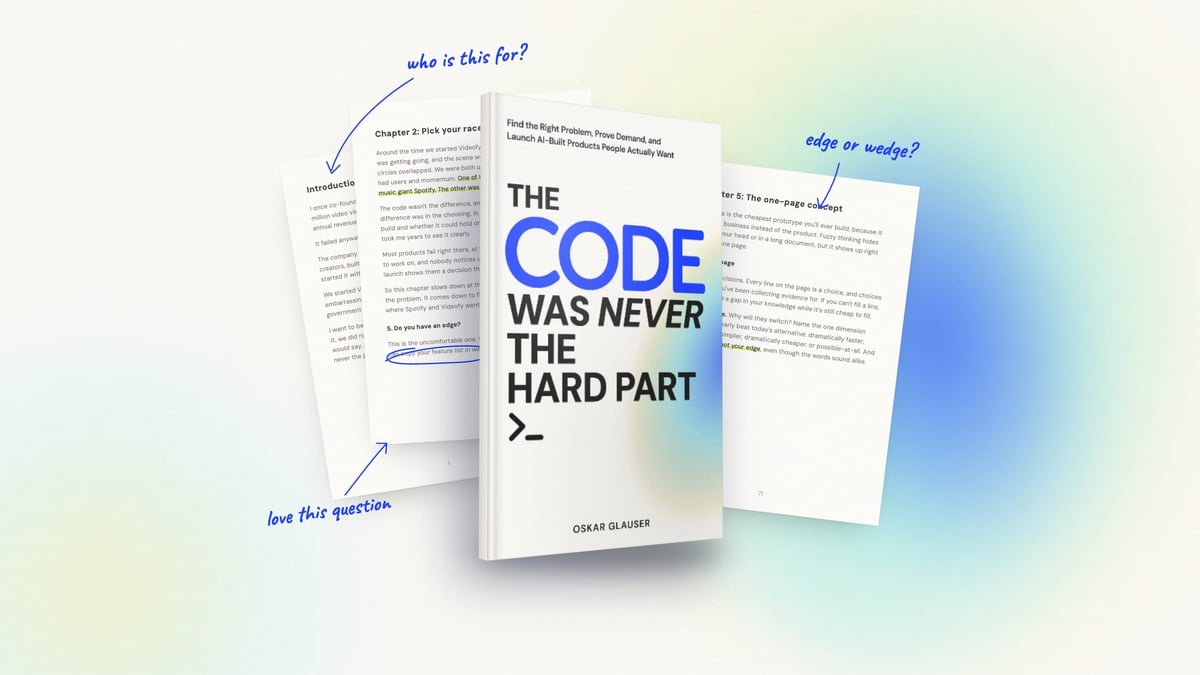
The one that made me happiest was about a single question. The book has a five-question filter for picking a problem worth your time, and the last question is whether you have an edge.
“‘Do you have an edge?’ I love that question. I use the same one when I look over my investments, and what you invest your time in might be the most important investment you make.”
Viktor, beta reader
That’s close to the whole point of the book, put better than I managed.
What they didn’t like, and what changed
The praise was nice. The criticism was useful, and there was more of it.
The question that came up more than once was who the book is actually for. One friend asked, with a smiley, whether I’d run my own filter on it. Fair hit. I rewrote the intro’s description of the reader to match the book’s own one-page concept, the same exercise the book asks you to do for a product. It now says plainly that it’s for someone who can build a working product with AI, often for the first time and usually next to a day job.
One reader asked for a cheat sheet at the end of each chapter, something to come back to without rereading everything. Chapters two to thirteen now end with a short box called “The short version”. A few weeks later, another reader picked out exactly those summaries as the part worth going back to. One person’s request becoming another person’s favourite part is the best argument for showing unfinished work I’ve come across.
A couple of readers said the same thing about the voice in different words. The book came alive when I told my own stories, and went flatter when it turned into instructions. So I went through the whole book to make it sound more like me, and chapter two now opens with a story instead of advice.
One reader asked the question I’d been quietly avoiding: why read this at all, when you could prompt a startup guide in thirty seconds? It now has its own answer at the back of the book. “A prompt can’t give you the order, which questions matter before which, or twenty years of my own mistakes with the numbers attached.”
Two readers found the early draft too dark, and one said it read like a book for people who build alone. Also fair. A lot of the book is about the expensive ways things go wrong. So the intro gained some hope, and a thread now runs through the later chapters about not having to do this by yourself: teaming up, finding someone to think with, sitting with other builders.
Then the smaller fixes. One reader couldn’t tell whether I meant edge or wedge, because the book uses both words for different things and I hadn’t made the difference clear. Others asked for pictures, so the book now has figures where words were doing a diagram’s job.
What I didn’t change
Not everything made it in. One reader thought the introduction was long, and it’s still on the long side. Another would have preferred the book in Swedish, which I understand, since it’s my language too, but it stays in English.
Listening to feedback isn’t the same as doing everything you’re told. The job is to understand exactly where someone stumbled, then decide what to do about it yourself.
The part I’m keeping
The most useful feedback was rarely praise. It was the specific moment someone got lost, bored or unconvinced, said plainly. And every time, the fix was smaller and more concrete than I’d feared: a sentence rewritten, a story moved up, a summary box added.
That’s the same thing the book argues about products. You don’t find out what’s wrong by thinking harder on your own. You find out by putting the unfinished thing in front of people and paying attention to where they stumble.
It’s out on 15 October on Kindle. If you want to see whether the changes worked, chapter one is free. And if you missed it, here’s why I wrote it in the first place.
Thank you to everyone who read it while it was still rough. You made it better.