Applied robotics is the opportunity
I spent a few hours recently trying to make a robotic arm pick up odd-shaped objects in simulation. Different sizes, different weights, none of them where the policy was expecting them to be. Mac mini M4, MuJoCo, an open-source arm model, the kind of stack you couldn’t have built at home five years ago.
It worked, sort of. I hit the wall where I’d need a proper NVIDIA box to push it further, because half the modern toolchain assumes you have CUDA, and a Mac mini does not. The bigger thing the experiments showed me wasn’t about my desk setup. It was about where the real opportunity in robotics is right now, and it isn’t quite where most of the attention is going.
The hardware is arriving
Unitree is shipping. Figure is shipping. Tesla’s Optimus has gone from concept video to factory floor footage. Industrial robotic arms that used to cost six figures are available for the price of a used car, sometimes a lot less. The thing that was a research project a few years back is now a purchase order.
I wrote about this trend recently, and it has only accelerated since.
The software for one robot is getting good
The control software has caught up in parallel. Foundation models that generalise across objects and tasks. Policies trained in simulation that transfer to real hardware. Open-source simulators like MuJoCo and Genesis that let one person prototype on a laptop what used to require a research lab. My Mac mini got me a long way before the CUDA ceiling stopped me. You can taste this work from a kitchen table now, and that’s new.
One robot isn’t a business
Here’s the thing that’s easy to miss when you’re playing with a single arm. Most real applications for robots aren’t one robot.
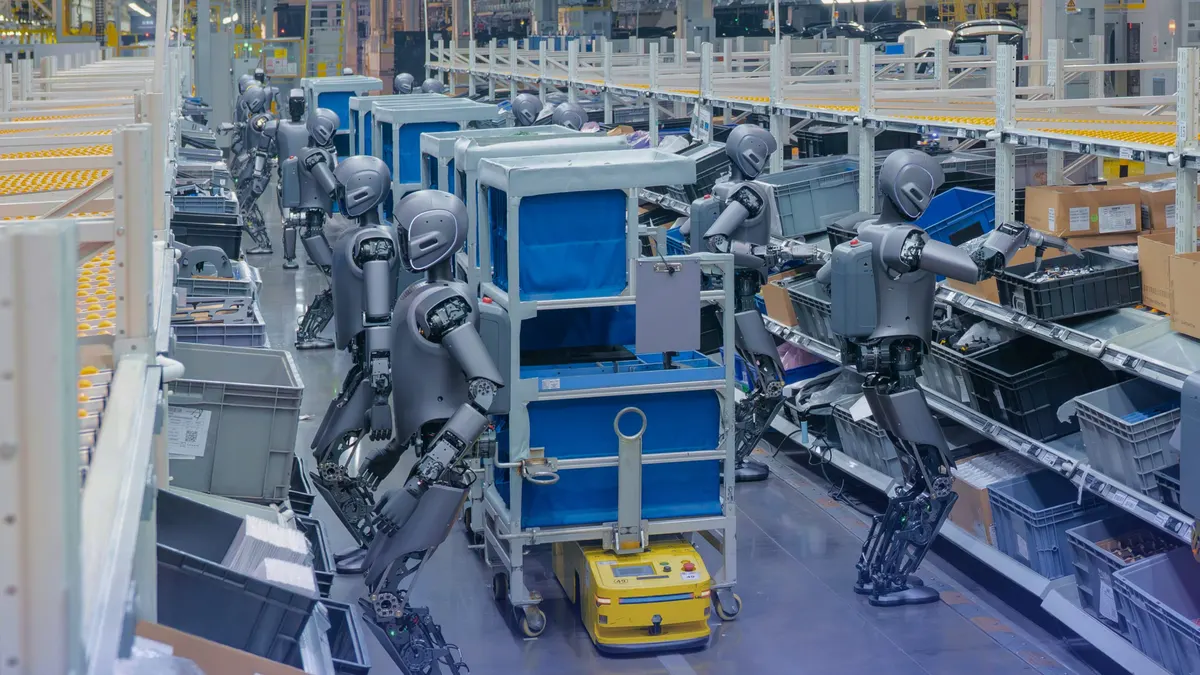
A factory floor isn’t one robot. A warehouse isn’t one robot. A food processing line isn’t one robot. A construction site, a port, a farm, a hospital logistics floor: none of these are one robot. They’re four, ten, a hundred, eventually thousands, working together on a workflow the business actually cares about. That’s a completely different problem from making one arm reliably pick up an object.
A redesign, not a swap
There’s another assumption worth flagging here. Applying robotics doesn’t just mean taking a process that humans run today and swapping humans for humanoids. That’s the easy version, and usually the worst one.
Most workflows in factories, warehouses, kitchens, hospitals and farms are shaped by what humans need: ergonomics, breaks, shifts, line-of-sight, the awkward height of a packing table, the printed work order, the room for two people to pass each other. A lot of those steps disappear, or look completely different, when machines do the work. Some you can delete. Others you can reorder. Some new ones, like charging slots, calibration runs, sensor checks, you have to add. You might even move the whole factory, to somewhere the rent, the labour market, or the supply chain look completely different now that the work isn’t shaped around people.
The real value of going into a business with applied robotics in mind is the redesign. You’re not just installing robots. You’re looking at the workflow with fresh eyes and asking what it should look like now. That’s where the gains jump from a few percent to multiples.
What’s already been built
The fleet layer isn’t missing. It exists in pieces, and it has for a while. The category usually goes by names like robot fleet management, robot orchestration, or RobOps.
There’s Open-RMF, an open-source framework that coordinates multiple robot fleets and the building infrastructure around them: doors, elevators, lifts. Strongest in hospitals and large facilities. There’s VDA 5050, an interface standard for AMR and AGV fleet managers to talk to robots, used inside NVIDIA’s Isaac Mission Dispatch. There are commercial RobOps platforms like InOrbit and Formant selling cloud tooling for fleet operations, telemetry, incident management and remote ops. And there are vendor-specific managers like MiR Fleet and OTTO Fleet Manager that handle task assignment, traffic, charging and enterprise integration for their own robots.
Tesla and Figure almost certainly have internal versions of all this. Figure 02 has been running 10-hour shifts at BMW and contributed to more than 30,000 vehicles, which doesn’t happen without serious internal fleet tooling. They’re just not selling it. I wrote about the technical shape of this layer last year; what’s changed since is that more of it has actually been built.
Why it’s still fragmented
The pieces exist. They mostly don’t work together.
Most of the commercial fleet managers are vendor-specific. MiR Fleet manages MiR robots. OTTO Fleet Manager manages OTTO robots. The moment a customer mixes brands, or combines humanoids with AMRs, or layers mobile manipulators on top of an existing AGV system, the tooling falls apart. The open-source layer is real but uneven. Open-RMF is strong in hospitals and buildings, weaker in factories, fields and ports. VDA 5050 covers only a slice of the interface and is mostly used in the AMR/AGV world, not for humanoids or arms.
InOrbit and Formant are aimed at the right altitude, but they’re early and the category is still wide open. The robotics companies I’ve talked to recently are mostly humanoid or hardware-first, and none of them have a serious fleet layer yet. To be fair, I don’t really know what I don’t know. Someone could be building a beautiful version of this quietly. But I haven’t seen the sign of it yet.
The honest picture is this. The building blocks exist. No dominant horizontal layer does. Most deployments still require meaningful integration to combine the available pieces with the customer’s existing systems: the warehouse management system, the ERP, the doors and elevators, the safety layer, the incident logs and activity records that insurance and compliance need.
And none of these tools help much with the bigger question: what should the workflow look like in the first place? They orchestrate robots once you’ve decided what the robots should do. The harder, more valuable work of redesigning the process happens upstream of any of them.
That’s the actual opening.
Two opportunities, not one
There are two distinct kinds of company that can win here, and they’re meaningfully different.
The first is applied robotics integration per industry. Pick a vertical (warehouse logistics, food processing, agriculture, hospitals, ports, construction) and become the company that walks in, redesigns the workflow for machines instead of humans, and then wires the available robots, models and orchestration tools together with the customer’s existing systems into a working operation. The systems integrators and software consultancies of the 2010s are the closest analog, but the work being automated is more valuable, and the gains come from rethinking the process, not just retrofitting it.
The second is the horizontal wedge: a Shopify or a Vercel for robot fleets. The smaller end of the market can’t afford a custom integration. A workshop that wants ten robots, a small warehouse that wants twenty, a regional logistics operator that wants fifty, can’t write a six-figure cheque to a consultancy and wait nine months for it to be delivered. They need a plug-and-play system: pre-built setups for common business shapes, dashboards and ops tooling that work out of the box, and an AI-coding-friendly layer where customising the workflow looks more like writing a prompt than hiring a contractor.
Shopify did this for ecommerce. They didn’t build a custom storefront for every merchant. They built a system where anyone could open a shop in a few hours, then extend it as they grew. The equivalent for robot fleets doesn’t exist yet. InOrbit and Formant are aimed somewhere near this altitude, but the category is still wide open.
I wrote yesterday about physical AI being one of the few durable moats left. These are the two slices of it I think are most worth a serious look.
What I’m doing about it
I’m not about to walk away from what I’m doing to start an applied robotics firm tomorrow. My side project list is already too long, and the next 6-12 months is committed elsewhere.
But if I were optimising for the next ten years and looking for somewhere with a strong tailwind, a real moat, and demand that isn’t speculative, this is one of the first places I’d look. The hardware is becoming table stakes. The fleet layer is forming, but no horizontal product has eaten the category yet. The applied integrators and the right cross-vendor ops product are both wide open, and I think the value is going to land in both for a long time. The arms are already on the shelf. The brain that runs them isn’t, yet.
If any of this resonates, or you’re already working on a piece of it, I’d genuinely like to hear from you. Drop me a line and we can bounce ideas around.